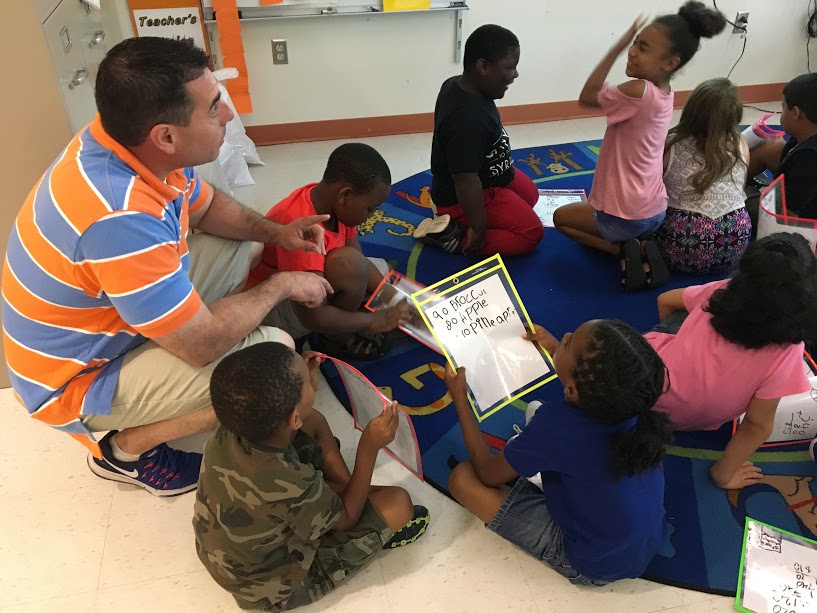
Think about things that you remember best from when you were growing up. What made those experiences stay with you for all these years so that they continue to make up your schema about what learning looks like? Chances are, those things you still remember engaged you or challenged you much more than worksheets or lectures. We call that level of engagement hands-on, minds-on.
Planning and implementing hands-on, minds-on learning experiences is different from opening a teacher's manual and writing down the page numbers. It takes a deep understanding of both the standards and your students. Creativity needs structure - and hands-on, minds-on learning experiences need structure in order to have a sense of freedom. Giving the freedom for your students to explore, create, question, and fail can be scary and it requires a classroom community that values risk-taking and a growth mindset.
Are you thinking about incorporating more hands-on, minds-on learning experiences in your classroom? Here are some tips to help you get started:
Plan tasks with multiple entry points. Having multiple ways to solve a problem or having tasks that build on solving problems allows students to see connections in what they are learning and explore possibilities rather than just solve for right answers.
Assign roles. Giving students roles helps them to engage and provides structures for the problem solving.
Start with the end in mind. Know what skills students will need in order to solve the problem in order to build those skills into the instruction and practice that you provide.
Teach kids how to fail. Teaching kids to have a growth mindset helps them understand that problem solving isn't just about finding the right answers - it's about learning and growing.
Use the real world. Multi-digit addition and subtraction is far more interesting to students when they have a real world problem to solve. Below, students are determining what they would eat if they had 800 calories and had to have a healthy diet. Multiple solutions, real world problem, and excitement about math!
I have written about this topic before - there is nothing more important to school turnaround than having the right team. That includes your leadership team, your teachers, your key supporters, and your consultants. The second part of this key competency is more challenging - right the remainder. You have to have your whole team rowing in the same direction and if there is even one person who is rowing against you, it can have devastating results.
I have been highlighting the Turnaround Competencies and Actions from Public Impact over the past several weeks because they are essential for turnaround leaders to consider as they plan for the upcoming school year (if you haven't reviewed them, please refer to them here). What ways will you address this competency during the upcoming school year?
Get the Right Staff; Right the Remainder (from Public Impact)
Require all staff to change: When turnaround leaders implement an action plan, they make the
change mandatory, not optional, beginning with accountable team leaders in the organization.
Make necessary staff and leader replacements: Successful turnaround leaders typically do not
replace all or even most of the staff, but often replace team leaders who organize and drive change.
After initial turnaround success, staff who do not make needed changes either leave or are
removed by the leader
Even if you have already started your school turnaround, you need to consider how you will "right the remainder" each year. I have been reviewing each teacher's data, determining strengths and areas for growth within teams, developing support plans, and mapping out the way I will deploy my resources in order to maximize the growth. Last year, I replaced all but one teacher on a grade level team because they were not maximizing their potential, working collaboratively, using data effectively, or getting results from their students. In 2015, there were ZERO students from that team who scored proficiently on our state assessments (on either ELA or Mathematics). The new team was in place for this school year and we learned Friday that we had 15 students score proficient on the Math assessment and 11 students score proficient on the ELA. This is cause for celebration! While we recognize that we are not where we need to be, we are definitely moving in the right direction and the team is now on the right path.
Right the remainder means having the right supports and the right conversations with your staff. There is not time in school turnaround to "hope" that staff or students "just get it." You must create a culture where it is the norm to challenge, to ask, and to even push back in order to always get better. If the school culture is not geared toward being able to have difficult conversations, doing what is right for children above what makes adults comfortable, and letting go of individual areas of self-interest in order to work collaboratively as a team, then you might have silos of superstars, but you will not achieve as a turnaround school. There is only time for what we know we will be effective - no time for some cutesy thing we saw on Pinterest or Teachers Pay Teachers. Teachers who are truly going to make a difference on your team have the ability to connect with other effective practitioners and say, "hey, I saw how you really produced results there, I want to learn more."
So, what we are talking about is hiring and supporting a growth mindset. How can you tell if you have created a culture that values a growth mindset in your school and why is it important to school turnaround? We have to focus on results in school turnaround, but because moving the needle on overall student achievement takes time and relentless commitment, you need a team that has the right mindset for growth and change over time. In this article, by Xclusive Fitness, they talk about the importance of a culture of development and having positive relationships with your team. The reality is that the right team is not just about working with your friends - it is really about being able to have difficult conversations with your team, hold them accountable, push them to be better, and still be able to know that you respect and care for one another. Creating that culture of collaboration, of challenge, and of unified purpose is key to school turnaround. In preparing for this upcoming school year, consider how you can support a culture of development in your school and with your teams.
I don't hear many people talking about the joy of leadership. The challenges, certainly. The frustrations, yes. The demands, most definitely. The work load, for sure. But, not the joy.
I believe that there is joy in leadership and that choosing joy actually improves achievement. I am not denying that challenges, frustrations, demands, and an overwhelming work load exist - just that seeing the joy in every day allows for us to see the wins amidst the challenge.
It's really a matter of mindset. Carol Dweck, in her book Mindset: The New Psychology of Success, explains how having a growth mindset, as opposed to a fixed mindset, can actually improve success and achievement. This applies to education, to learning, to a new skill, or to how you approach your role as a leader. Choosing a positive, optimistic attitude in your daily work and in your daily life can have a significant impact on the outcomes (find more info here).
Do you want to test your mindset? Check out this quick online quiz to see if you have more of a growth mindset or more of a fixed mindset.
And so, I choose to see the joy in the challenge, in the faces of the children, in the classrooms that are in love with learning, and in the promise of making a difference in a community. What is your joy?