Showing posts with label collaboration. Show all posts

Friday, November 6, 2015

Building Effective Teams

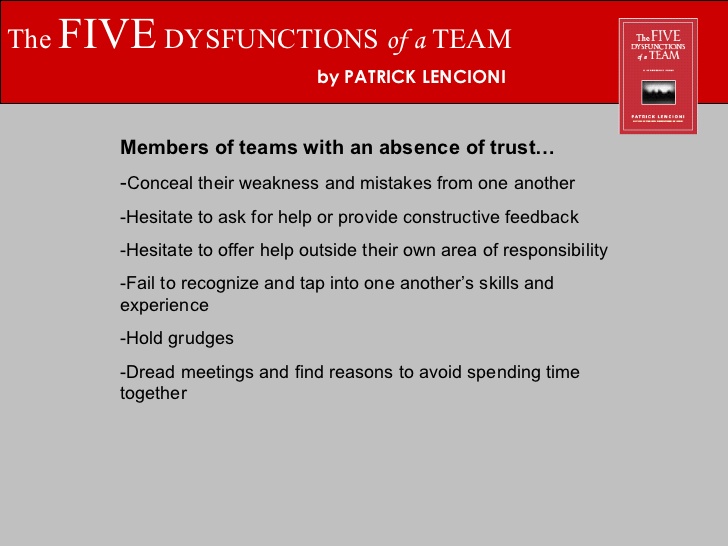
Let's talk about collaboration. The work involved in turning around a school cannot be done alone. It cannot be done in silos. It requires significant collaboration. What is collaboration exactly? By definition, collaboration is "a working practice whereby individuals work together to a common purpose to achieve business benefit." (http://www.aiim.org/What-is-Collaboration). Teams have to be able to build trust in order to be able to accomplish the significant work that faces them. But at the beginning of the school year, a group of people is thrown together and told that they are a team. They are told they have to make significant gains in student achievement and that they have to work together in order to do that. But, we don't do a lot to help the teams develop the skills necessary to collaborate effectively. In Patrick Lencioni's essential text, The Five Dysfunctions of a Team, the author outlines the components of true collaboration.
The foundation of the pyramid is about an absence of trust. It requires that teams share a level of invulnerability. We have to be able to share our insecurities, our imperfections, and even our failures with the people on our team. Without this ability to trust, we cannot become an effective team.

As a leader, we must be aware of the dynamics of building collaborative teams and provide support and guidance for teams who do not develop trust or who struggle with conflict. When teams lack trust, they are unable to move forward. When teams are only friendly and collegial, they may have trust, but they cannot sustain healthy conflict. We need to have vulnerability in order to build trust. We need to have honest discussions in order to build true harmony. As effective teams, we must all commit to common goals and find the ways to see the strengths in each of us. We should be able to set higher standards for one another and hold one another accountable when we let the team down. It is only through our collaboration that we will achieve. Silos of achievement will not turn around our schools. True collaboration and honest dialogue is the only thing that can truly move our teams and our schools. 

Saturday, June 13, 2015

Enriching collaboration

Collaboration. What does it look like in schools and how can you measure the results of that collaboration? This has been an underlying theme for us during year one of our turnaround plan. I believe that collaboration, much like creativity, needs some structure in order to thrive. All voices must be given the opportunity to contribute, to lead, to question, to push, and even to disagree in order for collaboration to be truly impactful and effective. I said to my colleague this week, "Politeness is poison to collaboration," and suggested that we might have t-shirts made with that phrase. What does that phrase mean to me as a leader and as a developer of teacher leaders? It means that everyone must feel that they are engaged in the direction of the dialogue, the development of ideas, and the evaluation of effective implementation in order for collaboration to work. If teachers feel that they can only share their true thoughts when they leave the room, it is not true collaboration.
Our enrichment partner (part of our extended learning time aspect of our turnaround plan) has been provided STEAM based instruction for our students daily while our classroom teachers leave the classroom for Collaborative Team Planning. In the beginning of the year, we operated without connectivity between enrichment and classroom curricula,even though we saw some beautiful products of the enrichment programming early on, we were missing the collaboration between our two systems. Throughout the year, we have engaged differently and more purposefully around planning collaborative units and projects. Our enrichment staff has willingly worked with teachers, instructional coaches, and administrators to see connections between the curriculum areas and develop lessons and units that build on and expand upon concepts taught in classrooms. As we have gotten better at collaboration, the work has become more meaningful to our students and to our teachers. As teachers have seen the multiple ways that creative thinking can enhance their content and curriculum, they have been encouraged to collaborate more with their enrichment partners and have found even more connections and ways to engage our students. 

We just finished a three day Celebration of the Arts this past week. It was amazing. Over three days, our students worked with a composer on a commissioned piece and presented the world-premiere of a work composed for our students, performed musical selections that aligned to the theme "I am the future," presented dance and instrumental performances, and hosted an Open House Living Museum for parents and families that included students reading stories they had written, dramatizing stories of kings, queens, fairy tales, pirate ships, and lost treasure, and created space ships, solar systems, and geodomes. This was the result of collaboration - between enrichment and classroom teachers, between school and community, and between students and teachers. This collaboration allowed our students to engage with the arts in ways that showed them who they are and who they can be. The arts can bring out the best in us and collaboration in the arts can unite a school community. Enjoy the images of our collaboration and the amazing things that our students created. It was so powerful to be a part of this collaboration (that's me - sitting at the piano). I am in awe of the things that great teachers can do with students when they are given the autonomy, mastery, and purpose to make great things happen.

Saturday, January 31, 2015

What is the Impact on Kids?

No matter what we are doing - whether we are planning, analyzing data, collaborating with teams of teachers, or looking at student work - we should be asking ourselves "What is the impact of this work on our students?" In other words, how are we making a difference each and every day for every single child we serve? This is quite a shift in thinking. If I am continually reflecting on what is the impact on kids, then when my students don't "get" my lesson or my approach - I adjust. I change it. I think about how I can reach and teach that child and I make adjustments. That is a very different approach from writing plans that I will teach no matter what.

We administered writing benchmarks as part of our turnaround goal to increase 75% of our students' writing scores by at least one point on the NYS rubric. Our grade level teams have been able to look at student work to identify trends (across classroom or grade level teams) and gaps (individual or small groups of students who lack specific skills or conceptual understanding). This has allowed us to plan more effectively - even within our curriculum - to give students more of what they need. The impact for our students has been clear as we see students who are aware of what quality work looks like and what they need to do differently to get closer to their goals. Involving students in understanding their own data by looking at specific growth on individual indicators within the rubric has had a powerful impact on students owning their own progress and targeting their own improvement.


So, what is the impact of using data to identify gaps and trends in student learning? Why is it worth the amount of time and effort that it takes? If we think about the amount of time that we, as educators, spend planning, wouldn't it make more sense for that planning to be targeted to the needs of students in order to ensure that we are moving students to where they need to be? If I give myself permission as a teacher to say, my team mate needs to focus on this strategy because that's what his/her students need, but my students need something different, AND then I share this thinking with my colleague through collaborative discussions and unpacking the standards - we both benefit from understanding our students more deeply and have increased our toolbox of strategies to meet different learners. The impact on using data to drive instruction is far reaching. Our students grow in their learning and understanding and are better able to meet or exceed grade level expectations. Our planning becomes more effective at reaching and teaching all of our students. Our school communities become more collaborative and better able to determine the specific competencies and skills that students must master to be proficient in the standards. It is time well spent and is the work that we need in order to turnaround our schools.