Friday, November 6, 2015

Building Effective Teams

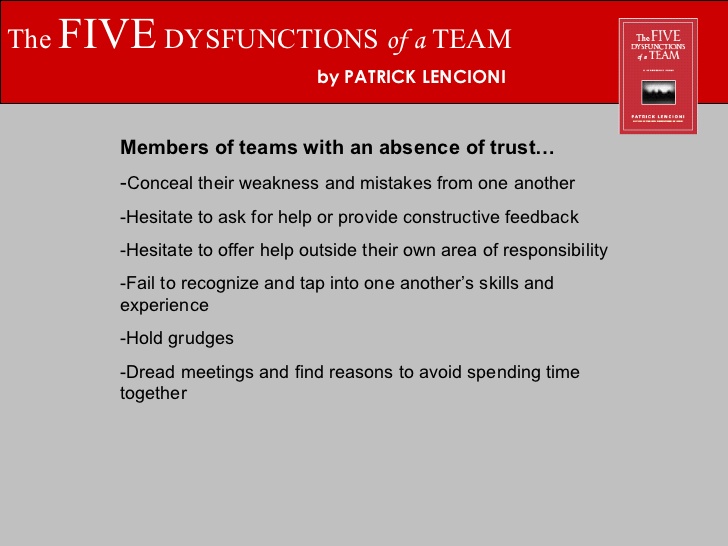
Let's talk about collaboration. The work involved in turning around a school cannot be done alone. It cannot be done in silos. It requires significant collaboration. What is collaboration exactly? By definition, collaboration is "a working practice whereby individuals work together to a common purpose to achieve business benefit." (http://www.aiim.org/What-is-Collaboration). Teams have to be able to build trust in order to be able to accomplish the significant work that faces them. But at the beginning of the school year, a group of people is thrown together and told that they are a team. They are told they have to make significant gains in student achievement and that they have to work together in order to do that. But, we don't do a lot to help the teams develop the skills necessary to collaborate effectively. In Patrick Lencioni's essential text, The Five Dysfunctions of a Team, the author outlines the components of true collaboration.
The foundation of the pyramid is about an absence of trust. It requires that teams share a level of invulnerability. We have to be able to share our insecurities, our imperfections, and even our failures with the people on our team. Without this ability to trust, we cannot become an effective team.

As a leader, we must be aware of the dynamics of building collaborative teams and provide support and guidance for teams who do not develop trust or who struggle with conflict. When teams lack trust, they are unable to move forward. When teams are only friendly and collegial, they may have trust, but they cannot sustain healthy conflict. We need to have vulnerability in order to build trust. We need to have honest discussions in order to build true harmony. As effective teams, we must all commit to common goals and find the ways to see the strengths in each of us. We should be able to set higher standards for one another and hold one another accountable when we let the team down. It is only through our collaboration that we will achieve. Silos of achievement will not turn around our schools. True collaboration and honest dialogue is the only thing that can truly move our teams and our schools. 

Sunday, November 1, 2015

Why Year 2 is Harder

I am a school leader who is turning around a failing school. Year one was challenging. We had to start from scratch with new staff, a new vision, an extended school day, and building a culture of academic achievement and consistent expectations where one did not exist. Year one was definitely challenging. Year two is just plain hard.

In the first year of school turnaround, everything felt like growth and improvement. We were coming from pretty much the absolute bottom in terms of student behavior and academic achievement. Providing consistent structures, routines, and expectations was difficult to implement, but not difficult to conceptualize. Establishing targets for grade level achievement required stretching, but we were also honest about where we were starting from, so our targets were ambitious but realistic. We were focused on progress. 

We are now in receivership and year two feels like the stakes are higher. We are no longer able to focus on progress alone - we have to focus on proficiency. We do not have time to waste on figuring it out. We need to have immediate responses that will ensure student progress. Feedback must result in immediate course corrections. New professional learning must be implemented into new practice. Teams must be able to collaborate, share ideas, support one another, and problem solve. As a leader, I must make difficult choices that sometimes make people aggravated because I must prioritize what is needed in my building above other things that may be happening throughout the district. This is lonely work. There is often no one else who can understand the pressures of being a turnaround leader. 

Here are some of my thoughts about keeping your head above water in year two:
  • Know your focus areas and be strong about saying no to things that do not support your focus. Our three focus areas for year two are Writing, Culture and Climate, and English as a New Language supports. Even our Receivership Recommendations align with these three focus areas so that all of the work we are engaged in moves our focus areas forward.
  • Use data wisely. Sometimes it feels like we are drowning in data. A wise leader will only ask for data collection when it is going to be used to inform instruction. What is the point of collecting data that does not inform your instruction? 
  • The other part of using data wisely is expecting that your teachers know their data and their students. That means that you as the leader need to know the data of students in your teachers' classrooms. You should be able to walk the walk and talk the talk. You cannot expect your teachers to know how to use the data if you do not know the data and how it should be informing their instruction.
  • Ask for help and be clear about what it is you need help with. Plenty of people will offer to help, but you must stay focused on what you really need. An example of this is how I have shifted my consultant support. In year one, we focused a good amount on leadership and coaching support - and that made sense because I was building a team and an infrastructure. In year two, I have asked for some of that support to shift and I am looking at building and empowering some of the promising practice in my building with video coaching and building a repository of effective practice as well as coaching for my enrichment program in the areas of curriculum development and alignment. 
  • Message what you mean. As a turnaround leader, there is no time for inconsistent messaging. That includes every single person in the system - from the front desk to the custodian to the teaching assistant to the parents. This can be particularly frustrating and requires that you "inspect what you expect" in terms of newsletters, conversations, and interactions. 
  • Appreciate your team. There is no way that this work is accomplished by a single leader - although the role of the leader cannot be underscored in turning around a school. Your team - your leadership team, your support staff, your teaching staff, and everyone in the system is working tirelessly to move student achievement. It can be very frustrating to feel like you are working so hard and someone (namely you) keeps telling you that it isn't good enough (or that is the message that is heard). Acknowledge how hard your teams are working and find ways to keep their heart and soul in it. I am always working to push myself in this area, but I try to acknowledge personally several people a week for the work that they are doing, I try to write several thank you notes each week to acknowledge contributions, we have random "Our Teachers ROCK" experiences where we do something fun for teachers, we end every meeting with "Appreciations" so that there is public appreciation for others, and I try to let me staff know in multiple ways that I completely have their back (even when I am asking them to grow). 
  • Know when to let go. You have to recharge. There is no one who can sustain this pace forever. In year one, I gained a significant amount of weight, I got mono, and I had no balance. In year two, I am just as driven, however, I am having to be much more realistic about what I can humanly sustain. I am eating healthier, walking and running, going to bed earlier, and even going on dates with my husband because I am not a superhero. I couldn't do any of this work without my husband, my sister, and my amazing leadership team supporting me. 
Year two is definitely harder. In year one, I didn't even know what I didn't know. Now, I am painfully aware of how far we are from where we need to be. But, I believe in backwards planning and I see clearly where we need to be at the end of this school year. I am diligent in ensuring that we will get there and I have a dedicated team who shares the vision. Wishing for a magic wand will not make it happen, so we must focus on where we can make the most progress and eliminate things that are not helping in order to arrive where we need to be. Destination: Achievement!

Friday, October 23, 2015

Instructional Rounds

Developing a culture that is open to feedback and reflection is essential to a turnaround school. One of the key strategies that I implemented when I began as a Turnaround Principal was Instructional Rounds. There are different names - Teacher Rounds, Rounds, teachers observing teachers, or classroom walk-throughs. Whatever you call them, the idea is similar to how doctors observe practice and use those observations to reflect and grow on their own practice.

In the book, Instructional Rounds in Education by City, Elmore, Fiarman, and Teitel, the author's outline the importance of peers observing other instructional practices, sharing feedback, and reflecting on their own instruction. This practice is powerful - and provides both observers and practitioners the opportunity to reflect on instructional practices and next steps.
I knew that I wanted to embed the concepts of rounds into the vision at Dr. Weeks, but I needed to accommodate the time that we had available, the size of our staff, and the desire to involve everyone instead of just a few teachers. I ended up creating a model within our collaborative team planning time (50 minutes daily) where teachers would meet for a pre-brief on an identified topic, observe in a classroom for 10-15 minutes, and then de-brief with the practitioner using a "warm feedback/cool feedback" protocol. We tweaked the routine as we moved forward, but the commitment to the rounds remained consistent. The teachers express regularly how powerful this tool has become for them - they have been able to increase their collaboration across grade level teams, they have become more comfortable asking for support with practice, and they have become more reflective about what they see in their own rooms and in the rooms of their peers. It never fails that I have an experience where I get goosebumps when I am facilitating rounds because there is some moment where that "a-ha" happens and you can watch the impact of this process in action.

This week, we did instructional rounds around writing - which is our instructional focus area. We spent two days observing writing practice across all content areas and in every grade level. One of the most powerful experiences was in a 5th grade mathematics classroom. In this classroom, students were working (and they were working hard!) on complex tasks by using the read, write, and draw strategies. The teacher was using over the shoulder conferencing with students as they worked independently. When a student expressed that they were stuck, the teacher asked questions to try and help the student become "unstuck" without giving the answers, and even shared exemplar student work with comments to encourage student thinking. The teacher took a picture of one student's work (not the student with the most complete response or the best writing) and put it immediately on the smart board. The student explained her thinking and then the other students coached her and asked her questions to move the exemplar student forward in her thinking. I was so excited that other teachers were able to experience this high level instruction. It is usually just administrators that get to observe this kind of excellence of both teacher practice and student achievement, but by using the rounds process, we had many teachers now able to participate in the process of observing and reflecting on how we define effective teaching.

The commitment to rounds is part of the vision that I have for our turnaround school - one with a truly collaborative teacher culture and where students are are academically challenged and supported. The time that we give to instructional rounds is scheduled in the calendar and maintained as a priority. If you can implement instructional rounds in any capacity, I strongly believe that it could be a gamechanger for you in terms of turning around your school culture and raising the level of instruction in classrooms.

Here are some great inspirations from our instructional rounds that might inspire you to take that first step.


Sunday, October 18, 2015

Meeting the Needs of Diverse Learners

I began my teaching career in a rural district in Upstate NY. To say that there was very little diversity might actually be an understatement. Although there were many challenges that faced rural schools - including servicing rural poverty, providing for a wide range of needs with limited resources, and designing instruction that would move students and the community towards a new future - everyone basically looked the same, had similar backgrounds, and had similar experiences.

I chose to become an urban educator because I wanted to experience diversity. I knew that there was more that I could do as an educator to learn and grow if there were different challenges in my classroom and in my school. Boy, was I right! My first teaching position in an urban district was in a school with a population that was 95% African American. It was the opposite of my previous teaching experience, which was rural and predominantly white, but it was still not diverse. Everyone in my first urban school was predominantly from the same neighborhood, similar backgrounds, and very little racial diversity.

My first experience with a significantly diverse population - where there are students and families from a variety of backgrounds, religions, with different languages, and from different countries all over the world was extremely eye opening for me. I was able to be an administrative intern at the school where I am now a principal, and that was my first true experience with significant diversity. We have 25% of our student population receiving ENL instruction. There are 20 languages spoken by students and families who attend my school. While 53% of our population is black or African-American, 47% is a rainbow of colors, backgrounds, languages, and belief structures. Teaching in such a diverse population has significant challenges. Leading such a diverse school community through school turnaround and receivership is unbelievably challenging.

I have classrooms with a wide range of learners in their classrooms. As I reviewed data from our initial running records administration, I saw classrooms with ranges from levels PA to V at 5th Grade. I have 1st and 2nd grade classrooms with 16, 17, 18, or 19 students receiving ENL services. So, differentiation is a hot topic in our feedback and planning discussions. We have been talking about defining differentiation as the place where our deep content knowledge and our understanding the needs of our students comes together. When we understand our content and our students' needs, we can make decisions about how we can individualize the way we will deliver the instruction to our students. Even in whole group instruction, we must be aware of the ways we deliver our instruction and provide opportunities for individual students to access the curriculum.

The Teaching Channel has partnered with the Oakland Unified School District to provide important video resources of key practices for differentiation - particularly for ENL students.  This overview is a key resource for teachers in diverse learning communities to gain insight into the ways that we can provide all of our children with access to proficiency with the new learning standards. In this video, supports for ENL students within the English Language Arts include a "talking rock" or a talking piece, which empowers students by providing them with the complete focus of the other students when it is their turn to talk. We have to remember that the curriculum does not tell us how to teach - it is not a script - it outlines what we need to teach in order for our students to be college and career ready. In our hectic and busy lives as educators (who are also trying to be spouses, parents, sons, daughters, friends, volunteers, and many other roles), we must keep learning as the focus. If we only think about teaching, we miss such an important opportunity to see our students in the driver's seat. Their learning, combined with our high expectations, is the key component. That is where the connection between our deep content knowledge and our knowledge of our individual students is the most vibrant: where our lessons reflect the kinds of differentiation that will ensure that all of our students succeed.

Here are some other resources that you might find helpful in your supports of diverse learners in your classroom:
http://www.casenex.com/casenet/pages/readings/differentiation/diffisisnot.htm

http://www.cdl.org/articles/differentiating-instruction-and-practice/

http://www.learnnc.org/lp/editions/every-learner/6776

Sunday, October 4, 2015

Creating a Culture of Achievement

I haven't written in a couple of weeks. I have been really engaged in the delicate balance of managing the immediate needs of where we currently are (which, by the way, is light years ahead of where we were this time last year!!) and planning for our future. We are part of a new legislation in New York that places struggling or persistently struggling schools in a status called "Receivership." To summarize receivership, it is the last chance that the lowest 5% of achieving schools in New York have to improve before someone else (an "independent receiver") steps in to take over. Although we have not made the kind of growth that we wanted or expected in terms of state assessments, we have plenty of evidence to support that we are really on the right track (for example, we are light years ahead of where we were at this time last year!!), so we have embraced receivership as a great opportunity to add more details to our plan and really think through what we envision from our school in 2-3 years. This kind of backwards planning is critical to the process of turnaround. If you can clearly see where you want to be at the end, and then you can articulate exactly what you need to do in order to get there, and you can allow for assessment and adjustments along the way, then how can you fail? Vision + planning + follow through = success.

But I digress. The real topic today is about achievement. The kind of achievement that permeates the entire of a school and of a community. The kind of achievement that hast parents invested and asking questions; the kind of achievement that makes it more cool for kids to be spending their time talking about reading or writing than it is for them to goof off; the kind of achievement that has teachers talking about best practices and ways to reach and teach kids - even over lunch or in the copy room. How does that shift happen? We worked so hard in year one to develop data protocols, make goal setting and achievement a living part of our culture, and shared data with our parents and families. Our students made progress - the growth was evident - but we really didn't achieve mastery. As we got deep into our data over the summer we knew exactly what we were missing. Our students were progressing and we were so proud of that growth, but they were not achieving the standards because we did not invest in sharing the standards with our students - we did not show them enough exemplar work, have them assess their own work against the standards using student friendly rubrics, and we did not inform parents and families about what grade level work is supposed to look like. In other words, we created a strong culture of learning, but we did not go far enough to fully develop as a culture of achievement.


 So, we are getting smarter. Our data meetings include more exemplars of grade level writing. Our discussions surround how we can align our expectations to standards, rather than letting our students define our expectations. That brings a real issue to the table - our students have been performing below level, and that has been a part of the culture at my school for many years (hence, the receivership status). So, making sure that we have the right strategies in place to move our students toward the standards becomes the work. In this video, a teacher prepares her students to dig deep into the work around theme in a novel and shares with her students the different levels of proficiency that they may be at in terms of this concept. There is real power in helping students to understand their own level of proficiency and be able to identify levels of proficiency in their peers. This is how we become more of a culture of achievement.
click here for mobile device

With all of this talk about standards, achievement, and classroom culture, it is so important to remember that creating a culture of achievement in classrooms is purposefully built. Teachers who are able to move their students toward this do not have a magic wand and they are not simply "better teachers." The same kind of backwards planning that I am using to move our school forward as a school in turnaround is the same kind of purposeful and backwards planning that teachers must utilize in creating a culture of achievement in their classrooms. Debbie Miller (in her book Teaching with Intention) talks about the importance of purposeful planning to achieve what you believe that students can achieve. If you believe that students can, and should, be engaged in discourse around standards, exemplars, and levels of quality work (and I certainly believe this!), then you must implement structures that build the capacity of students to do this. It will not happen overnight. And it is so important to persevere and make sure that you don't give up and let the student's performance define your expectations. If it isn't working, reflect on what skill students are missing and back track to teach that skill. Involve students in assessing their own progress. Allow them to reflect on how they can do it better. But do not give up and lower your expectations. Our students must have the same high expectations in their classrooms that we expect from our own children. This is the work - and it is so important.

Sunday, September 13, 2015

Creating a Vibrant Classroom Culture

As we return to our classrooms, there is energy, enthusiasm, and excitement in both teachers and students. It is not by accident that some classrooms seem to come together almost immediately - with students who are ready to learn and following the teacher's expectations from the first day of school. These classrooms, and these teachers, are not magical and they do not simply have better behaved students. On the contrary, these classrooms are purposefully built on clear expectations, practiced routines, and explicit procedures.


The time and effort that it takes to purposefully build a classroom community that will succeed in both academic and social emotional learning is well worth it. It is an investment early on that will result in increased self-management on the part of the students and more effective teaching for the teacher.

Here are some tips to creating a strong classroom culture with clear expectations:

  • Know your students. Greet them at the door. Provide opportunities for them to share and develop trust with you and with one another. Morning Meeting can be a great tool for this.
  • Start as you intend to go on. Build your classroom culture based on the picture that you see of how your classroom will function in May. Plan backwards to break apart skills that will be necessary to teach explicitly at the beginning.
  • Maintain high expectations. Provide opportunities to rehearse skills and practice procedures. When students require additional practice in order to meet your expectations - stop, provide supportive feedback, and encouragement when they make improvements.
  • Explicitly teach routines and procedures that will support the culture of learning in your classroom. How do you expect students to sharpen pencils? To get just right for me books? To get materials out of their cubbies? If you do not teach it, students cannot master it. 
  • Celebrate achievement. Take every opportunity to celebrate early wins and daily accomplishments. You will get much mileage out of positively reinforcing both individual students and classroom behaviors and academic accomplishments.

Tuesday, September 1, 2015

Welcome Back!

Back to school. It's an exciting time - and sometimes filled with some anxiety or trepidation. As we begin year two of turnaround - and year one of Receivership - I am filled with a combination of intense pride and apprehension about this upcoming school year.

My intense pride really focuses on my staff. I have shared before that my staff is absolutely amazing. As I look at them, talk with them, and listen to them - I am inspired by the level of commitment and the sheer skill they bring to the table. And this work isn't easy - there is so little reward for the amount of investment. My staff is working tirelessly and we are still seeing single digit student performance. Although we know that there are things we must adjust instructionally, it is not because they are not effective and amazing teachers. During these opening days with staff, my teacher leaders have led presentations and discussions on morning meetings, closing circles, restorative conferences and circles, ready to learn, and best practices about student de-escalation (we use something called a "Peace Place"). I have been filled with pride as I have watched our teacher leaders teach about the` best practices that we know will turn our school around. I have laughed, I have been moved, I have been inspired by the power that my teachers possess. I think about how amazing they will be when they have ten, fifteen, or twenty years of experience in making a difference - and I am overcome by the power and impact that they will have.

I hope that you have a wonderful back to school season and you see the power and potential that your team possesses in everything you do as a leader!


Here are pictures of teacher leaders modeling morning meeting, restorative circles, ready to learn, closing circles, and the Peace Place during our opening days with staff. I am one proud leader!