Sunday, July 16, 2017

Tips for hands-on, minds-on learning experiences

Think about things that you remember best from when you were growing up. What made those experiences stay with you for all these years so that they continue to make up your schema about what learning looks like? Chances are, those things you still remember engaged you or challenged you much more than worksheets or lectures. We call that level of engagement hands-on, minds-on.

Planning and implementing hands-on, minds-on learning experiences is different from opening a teacher's manual and writing down the page numbers. It takes a deep understanding of both the standards and your students. Creativity needs structure - and hands-on, minds-on learning experiences need structure in order to have a sense of freedom. Giving the freedom for your students to explore, create, question, and fail can be scary and it requires a classroom community that values risk-taking and a growth mindset.

Are you thinking about incorporating more hands-on, minds-on learning experiences in your classroom? Here are some tips to help you get started:

  1. Plan tasks with multiple entry points. Having multiple ways to solve a problem or having tasks that build on solving problems allows students to see connections in what they are learning and explore possibilities rather than just solve for right answers. 
  2. Assign roles. Giving students roles helps them to engage and provides structures for the problem solving.
  3. Start with the end in mind. Know what skills students will need in order to solve the problem in order to build those skills into the instruction and practice that you provide. 
  4. Teach kids how to fail. Teaching kids to have a growth mindset helps them understand that problem solving isn't just about finding the right answers - it's about learning and growing. 
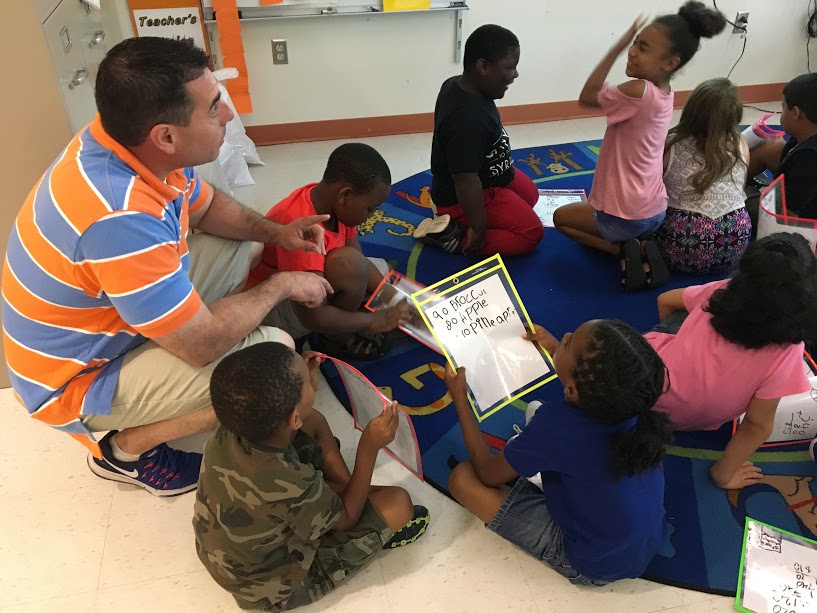
  5. Use the real world. Multi-digit addition and subtraction is far more interesting to students when they have a real world problem to solve. Below, students are determining what they would eat if they had 800 calories and had to have a healthy diet. Multiple solutions, real world problem, and excitement about math!

Saturday, July 8, 2017

Summer Learning Matters

I have been away from my blog for a couple of months - my oldest son just graduated from high school a few weeks ago and my parents celebrated their 50th anniversary, so I have been fully engaged in just getting through my regular commitments! I woke up this morning to thunder, lightning, and pouring rain, so it is time to get back in to my blogging routine!

This week, we started summer school. What do you think of when you hear the phrase "summer school?"

Well, urban dictionary defines summer school as "school that takes place in the summer - also known as hell." That is definitely not what we want kids or parents to think of when they are thinking about opportunities for learning! The research supports the need for engaging and authentic learning experiences, particularly for urban students, during the summer months to prevent summer slide.

Our vision for summer school was to make it fun for students and teachers - to completely undo that perception that summer school an awful, worksheet driven place where students and teachers are miserable. So, welcome to Summer Academy 2.0.

We envisioned a summer learning experience where students would be "hands-on, minds-on" and teachers would have the freedom to plan thematic instruction with the freedom to practice strategies and use materials that they wanted to use in order to build their own professional toolbox. We envisioned a summer learning experience that was more like the summer camp experiences that cost hundreds of dollars to send your children to - only we would do it at our school!

We have 10 themes and each theme carries throughout the day through ELA, Math, Writing, and Enrichment. In the "Down on the Farm" theme, students are reading decodable texts about farm animals, making omelettes in math using farm fresh eggs, and raising chicks.

One of our themes is called "Around the World" and students have passports that they stamp when they have mastered learning about a continent or a culture. Yesterday during math, the children had counted the number of states in the 50 states and they were discovering how many sets of 10 math cubes was equivalent to the number of states.


 In the "I, Robot" theme, students are learning to be engineers and began coding this week using Oz-bots.

Our "CSI: Classroom Science Investigators" theme is focusing on chemistry and chemical reactions. Students made pinch pots this week which they will be firing in a raku firing with a local artist.

Planning and implementing thematic, project-based learning takes time and a relentless commitment on the part of teachers. Seeing our students engaged, happy, and enthusiastic about their learning is worth it! 

Tuesday, May 9, 2017

Why Your Students Should Start a Blog - Take 2

I started my own blog in January of 2015 and it is one of the best things that I have done in terms of my own leadership; providing me an opportunity for reflection and a chance to think through my next steps. So, I am 100% behind the idea of supporting the students at my school in starting their own blogs.

Blogging provides students with an opportunity to write with a purpose - to take a stand on a topic and use research to support their opinions and to develop their own voice as a writer and an owner of ideas. This is what we want for our future generations - to be literate, to be well-spoken, to have ideas that they can support with facts, and to be creative. Blogging is a natural entry point into all of these aspects of being college, career, and life ready.

With everything that students can consume online, isn't it a better option for them to engage in being producers of a positive online presence? George Couros, whose blog I love, shared his similar points of view in his own blog (here). Our students can, and should, see themselves as having a positive influence and online presence. There are countless YouTube videos and Reddit articles for them to consume, but in order to truly make a difference in the world and in their community, they must have opinions that they can support and speak intellectually about - even when their opinions may be about pop stars or sneakers or fashion icons. Check out these children bloggers who certainly have something to say and who are making an impact with what they are saying here.


Here are some great resources for models when you are encouraging your students to begin a blog (remember that a model is important because it provides something that you either can choose to or not to emulate and that is important for framing kids perspectives):

https://childtasticbooks.wordpress.com/

https://meandthebigworld.wordpress.com/

https://millenniummacy.wordpress.com/

http://neverseconds.blogspot.com/

http://kidsblogclub.com/

https://turtleofhappiness.wordpress.com/

http://libdemchild.blogspot.co.uk/


Blogging is a vehicle for self-expression, reflection, and for making a positive imprint on this universe that we live in. In this time of anger, protest, violence, and confusion, isn't it important that we give our children a means to think through the questions that the have in a way that will help them to learn and grow and make a positive impact on this ever changing world in which we live.


Sunday, May 7, 2017

In appreciation of teachers

Teaching is the most important profession. The founding fathers knew that "an educated citizenry is vital to our survival as a free people" (quote attributed to Thomas Jefferson). Teachers and parents share the responsibility of ensuring that our children are prepared to assume their responsibility in this educated citizenry. In short, we teach the future. There is simply nothing more important than that.

Teachers in urban settings face seemingly insurmountable challenges with ensuring that our children are prepared with the skills they need to take their rightful place in the future. Teaching in urban schools is more than a profession - it's a calling. And urban teachers require a unique skill set. They must repeatedly go above and beyond - in supporting students emotional needs, in teaching social skills, in providing a constant balance of intervention and acceleration, in teaching English alongside the curriculum, in supporting communities that regularly deal with poverty, violence, and underemployment, and in planning and presenting engaging lessons that meet students where they are and push them to where they can ultimately be.

Urban teachers are superheros. They have to be. They demonstrate a relentless commitment to changing the world for the most vulnerable students each and every day. Celebrating them for a day or even a week does not do their work justice. They should be celebrated each and every day.

This past week, our students celebrated our teachers and our teachers celebrated our students. There were so many amazing stories, but this one just sums up how amazing urban teachers are and have to be.
"We were doing STEAM activities in our classroom. A student came up to me and said, "if everyday was like this, you know, no learning, we'd be good all the time!" We told him that he had been learning as a scientist and an engineer all morning. He said he wanted to be a robotic engineer after today and was going to ask his mother if he could go to summer academy to keep learning. "

This is why we do what we do in urban education.


Sunday, March 26, 2017

Do the Most Good - take 2

I originally wrote this blog post about a year ago. This seems to be the time of year when teachers and leaders wonder if the grass is greener in some other district. I think it is important for us to reflect on our level of commitment to the students we serve and the vision of our organization. As with any marriage or long-term relationship, commitment is a choice. We could always choose another way, but staying committed...that takes patience, communication, and work.

Why did you get into education? What made you decide to be a teacher in the first place? I think it is important to revisit this connection at this time of year because it is a time of the school year when there is a lot of contemplation about how things could be easier or better or more convenient in another school or in another district.

I don't think I thought about the impact I could have on other people's lives or on the greater community when I got into education - I was 23 and I was so excited to have a job - my focus wasn't on my role in changing the lives of children or families. Soon after I got a handle on my new position, I became aware of how my role extended past my classroom and into the greater community. As I grew as a teacher, I reflected on my role as a teacher and I knew that I had to admit that I knew that there was places where I could have a greater impact. That was my draw to urban education.

I believe that we need to "do the most good" - that if we are capable that we have a responsibility to help others.
While we can do good in any district, not everyone has the competencies for urban education. And urban education is where we have the greatest need. The children in urban classrooms need the absolute best teachers. They need committed teachers who have deep content knowledge, extensive strategies for managing classrooms, and who appreciate the diversity of our urban classrooms. While the grass may appear a brighter color of green in suburban districts, the reality is that the same grass grows everywhere. Urban, suburban, and rural districts all face challenges. However, the challenges in urban education cannot be solved without the best teachers working to overcome the disadvantages our children may have and strengthen the future of our urban communities. 

Urban teachers have to have strong classroom management skills and have a deep commitment to educating our future. Those are the teachers that we need in urban classrooms. And we need those teachers to stay committed to solving the challenges of urban education. Too often in urban education, we invest in developing a teacher with potential and then after a couple of years they think teaching will be easier somewhere else. Suburban schools are smart - they know that successful urban teachers can be successful anywhere. However, the inverse is definitely not true. It takes grit to be an urban teacher. Anything that is worth doing in life will have challenges. There are classrooms everywhere - but really making a difference means teaching where you can do the most good. Even when it is tough. They say that teachers aren't "in it for the income - they are in it for the outcome." Being the one who can help to shape the future is the best perk that we can have as a teacher - better than summers off or great health insurance or snow days. We are opening doors to the future. 

Sunday, March 19, 2017

What does it mean to be college and career ready?

My oldest son is a senior in high school, so the idea of college and career ready has a duality to me as both a parent and as an educator. I am seeing my seventeen year old son, who has so much academic potential, lack so much in the way of the soft skills that will determine success or struggle in college or career. I am continually trying to find the balance between pushing my son and letting him fail forward. It is the same for us as educators - trying to find the balance between academic proficiency and the kind of self-management and independence that will ultimately make the difference for our kids.

In this article from Educational Leadership called "What Makes a Student College Ready?," the author identifies four key pillars that relate to college success - Key Cognitive Strategies, Key Content Knowledge, Key Self-Management Skills, and Key Knowledge About Post-Secondary Education (Educational Leadership, 2008, 66:2). As a parent,  I am concerned about my son and those self-management skills - things like being able to get up on time, manage his own time, manage his own deadlines, and manage the stress of everything happening at once. As an educator, I worry about the students in my school who lack key content knowledge because they have struggled with being below grade level or they lack experiences that would give them prior knowledge to connect to. I also worry that so many of our students lack knowledge about post-secondary education and that will impact their ability to successfully complete college and be ready for a career.

David T. Conley (2010)
Our children, both biological and school, must have support from their teachers in being ready for college or career. Ensuring that our students have the skills that they need starts in elementary school and continues throughout their schooling. If we are going to ensure the future of our communities, we must ensure that our students have the skills they need to be ready for college and career. That's what I want for my own children and for the children in my school.


Sunday, March 12, 2017

Dear New Teacher

Last weekend, I traveled to New York City to talk with potential teachers about the great things happening in my district and why they should consider a position in the Syracuse City School District. I met some extremely talented people with great potential and experience. In a meeting with Hunter College, I was asked what I look for in a high quality candidate. I was reminded of a letter I had written last summer after interviewing a number of potential candidates.

Dear New Teacher,

As you prepare to interview for a position in the field of education, whether it is for a daily substitute, a long-term substitute, or a probationary position, please take a moment to consider what you believe in and how we will see those beliefs come through in your interview. Your interview is the first step in establishing yourself as a professional - you must have a sense of who you are as a professional and what sets you apart from the other candidates who will walk through my door. There will be tough questions - about instruction, about classroom management, about teaching to get results - your answers should show that you have some experience thinking about these things. Please give this some thought. If all you know about differentiating instruction is "centers," then you need to really dig deeper. Your interview should set you apart and show that you are a well-read, thoughtful, and purposeful candidate who is going to be 100% committed to the children in my school. That's what I am looking for. I am looking for passionate, dedicated, hard-working individuals who will make a difference in the lives of my kids - what have you done, either personally or professionally, that demonstrates that and how will you make sure that I know you are the one that will make that difference? 

Our children are our most precious resource. Every minute that they are in classrooms must be purposefully crafted to move them closer to proficiency and intentionally implemented to ensure they have the skills they will need to be successful in their lives. New teachers must be able to take feedback, be coached, and see their practice with a growth  mindset. If you struggle with receiving feedback, being coached, or if you need to feel like you always have to get a gold star, you should spend some time reflecting on how that might get in the way of teaching for results. 

I need to see how you are going to love my kids. But not in that "oh, sweetie" kind of way. Love them enough to expect amazing things from them. Love them enough to have high expectations and consistency. Love them enough to be consistent in your planning, preparation, and instructional delivery so that they know you are always giving them your very best and they will give you their very best as a result. Love them enough to teach them that they can achieve academically and that they cannot act foolish. Love them enough to see past their surface and see them for who they can be. That's what I need from you, New Teacher. I need you to understand how important your role is. You have the power to change the world. You have the power to change lives. You will make the difference. 

With optimism,
Principal Reeve-Larham


Sunday, February 12, 2017

What's the Size of Your Leadership Footprint?

We have all heard of a carbon footprint. Time for Change defines your carbon footprint as the "sum of all emissions of CO2 (carbon dioxide) that were induced by your activities during a given time frame." The challenge with a carbon footprint is to reduce the size of your footprint in order to lessen the impact that our energy use has on the environment (and yes, climate change is real, but that isn't the point here).
http://ib.bioninja.com.au/

Let's think about the size of your leadership footprint.

What? You might think this is a crazy analogy, but consider that the carbon footprint is basically measuring the impact that your energy consumption is having on the planet. Whether you are a school leader or a classroom leader, you want to have an impact on your students or you wouldn't be in education, so you need to consider the size of your leadership footprint.

Think of your footprint like this - what happens when you are not in the room? As a classroom teacher, have your students internalized your routines, procedures, beliefs, and expectations to the point where they remind one another, help one another, and hold one another accountable? What is the impact that you have on other classroom leaders throughout the building? Do they look to you to set the pace or the expectations for classroom management or academic rigor? For school leaders, how does the vision live in your school? When you are not there, how is the vision reflected in the everyday work of the school?

I think about this idea of evidence of impact all of the time in my work as a school leader. I have watched so many urban schools get started on the process of turnaround, only to lose a key classroom leader, lose funding, or lose a leadership team member and experience huge setbacks as a result. When we experience staffing changes, we have to consider the footprint in order to plan adequately for sustainable programming and ongoing impact. I know that when I left the classroom to pursue administration, the impact was significant because I had a really big footprint as a teacher leader. It is important to plan for the development of teacher leaders so that you can always manage the leadership of the vision while also creating opportunities for classroom leaders to stretch their growing edge.

Consider your best teachers. The ones who have leadership positions in the school, who hold the history of the families, who earn the admiration and respect of their colleagues and the students, and who get results. Those teachers have a huge footprint in terms of how you are moving your school vision forward and implementing positive change. Those teachers are irreplaceable. If you haven't read the report called The Irreplaceables by TNTP (http://tntp.org/), I highly recommend it. It underscores the idea of a classroom leader's footprint. Developing and supporting classroom teachers to have a big footprint in your school is essential in school turnaround efforts. Make sure that you are recognizing and acknowledging those teacher leaders because you cannot afford to lose them.


Evidence of our impact. That's what we are looking for. The size of your leadership footprint indicates the impact that you have on everything in your school. What's the size of your leadership footprint?


Saturday, January 28, 2017

Diversity Makes Us Stronger

Last week, my school had our Winter Concert. The music was wonderful and seeing all of our students performing with confidence in a variety of musical genres and singing in parts made me incredibly proud. So much to be proud of - but there was something that really inspired me in addition to the music. So many of the students on the stage spoke little or no English when they came to my school, and yet they were on the stage with every other child - grinning, proud, singing, doing the motions, and being included. Their parents, who speak Spanish, Arabic, Swahili, Kinyarwandan, Karen, or Chinese, beamed as they saw their children on stage performing - fully a part of the school community.

Why does this story matter today? Today is the day to share this story so that it can impact someone who has never been fortunate enough to experience the power of diversity.

According to the National Park Service, The Statue of Liberty has been referred to as "The Immigrant's Statue" since the late 1800's. Emma Lazarus' famous poem, which is engraved onto the pedestal of Lady Liberty, rings out with the words


"Give me your tired, your poor,

Your huddled masses yearning to breathe free,

The wretched refuse of your teeming shore.
Send these, the homeless, tempest-tost to me,
I lift my lamp beside the golden door!"

For me, these words have always underscored a commitment. They are an invitation. They are the theme of our country. At least, that is what I have been taught and I have believed. 

A newly arrived immigrant family on Ellis Island, gazing across the bay at the Statue of Liberty from National Park Service


The current administration's decisions regarding immigrants and sanctuary cities is reactionary and panders to the uninformed, the privileged, and the afraid. Diversity in our schools, and in our country, makes us stronger. Learning from the stories of others strengthens our own story and shows us how we can be a better version of ourselves. As educators, we see the power of learning each and every day in our classrooms and in our schools. We know that a community must have diverse ideas in order to thrive. The time is now to use that power to make sure that children from Syria, from the Congo, from Burma, from Afghanistan, have the same opportunities that young Irish or Italian children had 100 years ago.


Saturday, January 14, 2017

A Case for Personalized Learning

Personalized Learning. It's quite a topic in education right now. But, personalized learning is not new - it has taken on a new life as our need for differentiation has grown. A colleague asked me to consider the challenges of the one-room school house and consider it as a model of personalized learning.
 Today's classrooms look very different than the one-room schoolhouse, but the challenge is similar - full classrooms of students at varying levels with one teacher trying to figure out how to push students toward mastery. Our teachers today have the additional challenge of standards, state testing, and school improvement measures. We also have an amazing opportunity to use digital tools in our classrooms and to use those tools as a way to reach the goal of truly personalized learning.

Personalized learning isn't just about digital tools. It is about knowing your students, knowing their data and the strengths or gaps in their learning, knowing effective standards-based instruction, and knowing how to build student ownership of their own learning. Education Elements, who are some of the foremost thinkers about personalized learning, define the core four elements of personalized learning as Targeted Instruction, Data Driven Decisions, Student Reflection and Ownership, and Integrated Digital Content. 
From Education Elements - Core Four Elements of Personalized Learning
With all of the work we have invested in using data to drive our instruction, it seems like everything points to the Core Four Elements of Personalized Learning as a logical step. Using data to drive your instruction ultimately leads to personalized learning - and the right digital content can ensure that students are engaged in effective, standards-based learning. 

Digital tools do not replace teacher actions - they should enhance the effective, standards-based instruction that is happening in classrooms. Classrooms might feel like the old one-room schoolhouse with the levels of necessary differentiation, but today's classroom should look much different. Today's personalized classroom reflects the availability of technology and information and is rooted in individualized goal setting and personalized growth. If we are truly committed to providing our students with a high-quality education that prepares our students for college and career, this level of personalized learning is the next step in our journey. Digital tools, in combination with data driven instruction, effective standards-based instruction, and students involved in setting their own goals and monitoring their own progress are changing the way our classrooms look and the way our children achieve. 

Sunday, January 8, 2017

What Our Kids Need

When you think about the students in your class, how do you know them? Do you know them for the behaviors they show in your room or throughout the school? Do you know them for the gaps in their learning and what their data reflects? Do you know them for their lives and what they bring to school with them each and every day? Do you know them for who you think they are or do you really know each and every child in your class?

Really knowing your students means knowing their lives - their real lives - and bringing that understanding into your support and guidance for your students. It doesn't mean that you lower your expectations for them based on what you know about their lives. If anything, it means that you have consistently high expectations, but you also have to have compassion and understanding. 

This article, published on CNN, talks about children in Chicago learning to dodge bullets before they are five years old. According to the National Center for Child Poverty, 47% of American children are from low-income families and 66% of those children are African-American. The American Psychological Association  indicates that poverty has significant impacts on children in many ways, not the least of which is academic performance. 
From American Psychological Association
Educators must know and understand how they can best support children living in poverty without judgement or condemnation. Our children didn't ask to be born into poverty. Parents want what is best for their children. That leaves educators to ensure that our children have whatever they need to help them break the cycle of poverty - social emotional strategies and practice, high academic expectations, and a vision of themselves in the future where they are of value and valued. 

from Children's Defense Fund
Our kids need educators who are committed to giving them the skills they will need to break the cycle of poverty - reading, writing, and math skills that will help them be competitive, social emotional skills that will help them solve problems and cope with the challenges they face, and supports for parents and families struggling with addiction, insecure housing, unemployment or underemployment, and/or mental health issues. The field of education needs people with vision and a relentless commitment to doing whatever it takes to making the future better for our children. We need people with creativity, with compassion, with a commitment to high expectations and doing whatever it takes to help change our communities so that children do not have to grow up learning to dodge bullets before they learn how to read.

Monday, January 2, 2017

Goals for the New Year

It's time to go back to school and the calendar has turned to another year. As we return to school, it's time to take stock of what is working and what needs to be adjusted in order to move our students closer to proficiency.

How do you know where all of your students have made growth and where you measure up? It is time to review all of that data and develop an action plan for moving forward.

Having a system to track, review, and compare data is essential for any school. We use a system developed in Microsoft 365 to share our data, but any system of tracking and sharing data works, as long as it is consistently used and everyone agrees on the data points. 

Having data doesn't do any good if it isn't being used to design targeted instruction. Today's teachers must be able to must be data experts who use data to plan instruction that meets students where they are and moves them to the next level. 

Moving students to the next level can be extremely overwhelming when you have large numbers of students who are below level, so it is important to set short-term, as well as long-term, goals. Many new teachers get stuck here - wasting valuable time on lessons that don't move students closer to the goal. Your long-term, or year end, goals are similar to the concept of planning for college as soon as your child is born. You know that you have to begin the savings account, you have the conversation with you spouse, and you set a goal of how much you would like to have saved by the time your child is eighteen or ready to go to college (and trust me, it won't be enough). Short-term goals are similar to your plan to actually put the money in the account - whether you use a 529 or a savings account, you have a system to put away the money each month and then you progress monitor to see how close you are getting to your goal. It's actually the short-term goals that you can adjust and make changes to in order to get you closer to your long-term goal. So as important as the end of the year goal is, if you are not setting short-term goals that will get your students closer to the mark, and then reviewing each and every day to see how much progress they have made, you will find yourself short when it really comes time. 

So, it's time to measure up. How much progress have your students made to date? Where are your students in terms of the year-end goals? What teacher actions will you implement in order to move your students over the next 6-8 weeks? Here is an example of a tool for planning your mid-year data discussions and instructional planning. 


Thursday, December 29, 2016

Public Education is Worth Fighting For

Public Education is about to venture back into the debate of charters and vouchers as options for turning around our struggling schools. With the appointment of Betsy DeVos as Education Secretary, Public Education is again being threatened by another "transformation" that is meant to raise standards and provide for excellence in American classrooms. However, with a focus on repealing the Common Core State Standards, providing vouchers and funding charter schools, there is little hope that this refurbished approach to transforming American education will do much more than frustrate high quality educators and leaders who have invested their lives into educating future generations of American children.

As a leader of a struggling school that is a completely different place than it was three years ago, I have a few pieces of advice for the incoming Education Secretary - not that I think they will be heard, but I have decided that if I do not use my voice to advocate for what I believe in (aka Public Education), then I am not being true to myself as a leader and I am not showing my community what I believe in and am willing to invest my time and effort into.

Common Core - Why does the Education Secretary want to repeal the Common Core? Her tweet, "Many of you are asking about Common Core. To clarify, I am not a support - period," (read more here) has been retweeted and quoted throughout the news cycles. The Common Core State Standards has put the need for more rigorous, student-centered educational practices that build on conceptual understanding the center of classroom planning and practice. How is that hurting anyone? The whole idea behind transforming our education system is that American students lag significantly behind students from around the world (see chart below) and in a global economy, we simply cannot afford for American innovation and business to continue to lag behind. 

While the roll-out of Common Core and the connection to APPR were highly (and rightly) criticized, the need for rigorous discourse, high quality instruction that builds on conceptual understanding, reading complex text, and writing across the content areas continue to be the best parts of Common Core and should not be "watered down" in the name of "transformation." The Common Core is not the problem in America's schools - if our students cannot meet the standards, we must look at effective leadership practices and effective classroom practices that will make sure that our students (that's ALL students) get the high quality instruction that they deserve. 

Vouchers and Charters - I can hear it now..."What's the big deal? If there is more choice, that will force schools to be better if they want to keep students!"Here is the real deal...it takes a considerable amount of time and effort to turn around a school. I am on year three and we are really starting to see gains across all areas. However, we have not yet reached a tipping point where the majority of our students are performing at or above their grade level. Public school dollars support charter and voucher programs that allow for students to leave public schools and attend a school of choice, which has a devastating impact on the resources available to students and in classrooms. Public schools have an obligation to provide the highest quality education to all of our students in order to have an educated citizenry and that requires having adequate resources. We cannot educate the future of our communities and our country if only some students are given the opportunity to experience excellence. 

Teacher Preparation Programs - In the past twenty-five years that I have been in education, there has been very little public debate about the quality and expectations of Teacher Preparation Programs. There is a significant amount of debate from within education, but no one else has really seemed to take on the challenge. I would encourage Betsy DeVos to take this on as one of her important first challenges - more important than Common Core revision, ESSA, or even the Voucher debate. Without having top notch teachers in our classrooms, very little matters about what the laws and regulations state about what we need in American classrooms. What we need, more than absolutely anything, is the best teachers ever. That will definitely require that colleges make changes to their programs. It will require that teacher preparation programs look much more like doctor preparation programs. And it should require changes to the salary scales for teachers as well - if we are expected to train like doctors, we should be compensated like doctors. After all, we are saving lives, too. 

So, my challenge to incoming Secretary of Education, Betsy DeVos, is more of an invitation. Come and visit. See first hand who American children are, what American children are learning, and American teachers are teaching. Talk with high quality school leaders who are training the teachers who are coming out of our Teacher Preparation programs over the course of three years or more in order to make young teachers who have just stepped into the classroom into effective practitioners. And lastly, I would ask you to remember that educators are making investments in our future each and every day. We wouldn't ask Wall Street Investors to make a promising future without the appropriate resources - likewise, our public schools need the resources to ensure a bright future for ALL of our children. 


Sunday, December 4, 2016

Developing Leadership Opportunities

One of the key components of leadership is developing the next generation of leaders, whether that is classroom leaders, model classrooms, or school or district level leaders. We have an obligation to ensure that the leaders who come after us have a mindset and beliefs that will serve the students of tomorrow and provide them with the absolute best education. In some ways, that means that leaders are always developing teachers out of the classrooms in their own building, which can have a significant impact on the instructional program in a school. So, it is necessary to have a leadership development plan.

Developing a leadership development plan starts with your own leadership as the school building leader. You must have an idea of where you need to learn and grow if you are going to model and create opportunities for leadership development in your school. As a leader, you must learn and grow alongside your staff - simply providing them with opportunities to learn is not enough, and expecting them to learn for you is poor leadership. In an article in the Harvard Business Review, Deborah Rowland cites that many employees do not trust their boss and that most in-house leadership development is less about "doing leadership" and more about "how to do" leadership. As school leaders, we must start with ourselves if we want to develop highly effective leaders.

Having a leadership plan requires a common language around the competencies of leadership. There are certainly many to choose from - I have used the Turnaround Leadership Competencies by Public Impact for myself, my leadership teams, and my classroom leaders. Hearing my teacher leaders talk about recognizing the early wins or requiring all staff to make changes is exciting and it underscores the importance of having that common language throughout an organization in order to make substantive change. Here is an example of a self-assessment tool that leaders can use when beginning to make a leadership development plan.


The next levels of leadership vary based on the size of your system. Identifying these levels of leadership is essential for any strong leadership development plan. In my system, I have a leadership team (their primary role is leadership within the building), teacher leaders (they have additional leadership responsibilities that they have taken on outside of their classroom role), team leaders (they are the key person on their grade level team or department), and classroom leaders. There is some crossover between the layers of leadership, as some people are involved in multiple levels of the work.

My responsibility as the building leader is to distribute the leadership of our school vision through internal leadership and also provide opportunities for them to learn and grow their own skill set. Within this system, I have several leaders who aspire to be building leaders, several who wish to become model classrooms or instructional coaches, and some who are working on developing stronger communication skills within their grade level team. Differentiating leadership development and opportunities for growth requires that school leaders know the skill sets and leadership capacities of their staff as well as creative opportunities for leadership to live in your school. Leadership development also requires clear visioning, strong communication regarding the vision, and regular feedback and check-ins. Two-way communication and checking-in on progress have to be a priority in order for budding leadership to grow and yield the expected results.


Saturday, November 26, 2016

How Can You Tell If Your School Has "Turned Around?

There are many components of school turnaround - suspension and referral rates, student achievement measures, attendance, parent involvement, staff turnover, and school climate to name a few. With so many moving targets, how can anyone ever know if their school has really "turned around?"

Even the idea of "turnaround" is somewhat of a misnomer. Moving a school from significantly underperforming to achieving takes time. It's not as if there is a magic wand that can take a school from one end of the spectrum to the other overnight. When we talk about school turnaround, we are really talking about significant school improvement and being able to see improvement in the terms of any of the indicators previously listed is an amazing thing to see.

There are many voices in the school turnaround debate. Advocates range from strategies that involve closing schools and re-opening them with new leadership, new staff, and new curriculum to strategies that involve supporting the whole child through addressing the issues of high poverty. No matter what the approach to school turnaround, the research supports the need for strong, visionary leadership in implementing a school turnaround plan that yields results.

This is my third year as a turnaround principal. My school has made significant gains in reducing suspensions and referrals, in improving student achievement, in improving attendance rates, in engaging parents and families, in reducing staff turnover, and in creating a school culture that is a productive learning environment and values achievement. This week, New York State released the Demonstrable Improvement Index for schools in receivership. This score indicates an overall improvement rating based on metrics that were selected for that school. Schools were given points based on meeting the targets set for each metric. The school I lead scored a 92 out of 100. Maybe I should say that in a little different way - how's this?

92 out of 100!!! That's amazing!!!

This acknowledges and underscores our hard work and improvement efforts. We are working tirelessly to make greater gains in student achievement and to continue toward being a model school in school turnaround. To read more about our demonstrable improvement index, our metrics, out turnaround efforts, and our school community, click here.


Friday, November 18, 2016

When Thinking is Visible

How do we know that there is really deep thinking, measurable learning, and significant growth happening in our classrooms? If you have followed any of my previous posts, you know that I am pretty passionate about classrooms where there is a high level of rigor, real life engagement, and deep thinking. I love thinking about rigor as "cognitive demand" - in simplest terms, who is really doing the thinking and the work?

This past weekend, I attended the NYSRA Conference in Rochester, New York. One of the most interesting sessions that I attended was by Maureen Boyd, a professor at University of Buffalo, which focused on classroom talk (find her book here). Although the idea of classroom talk seems simple, when you think of classroom talk as visible thinking, it takes on a different shape. Dr. Boyd talked about the power of the "third turn." The initial question is the first turn. The student response is the second turn. The power comes in the third turn - what the teacher does in response to the student response. The teacher can either elevate the thinking in this third turn by asking an additional question or asking for additional student responses, or the teacher can stop the thinking in the third turn by simply saying "okay, good." If the teacher's response ends the thinking, then the student only responds for the purpose of answering the question and getting a correct response - that is definitely not visible thinking. If you really want to learn about what students know or understand, you have to be willing to listen to student responses and all that they show you about what students do, and do not, think.


As School Leaders, it is our responsibility to know the kind of questioning, discourse, and thinking that is being asked of our students in our classrooms. When we see instruction that does not push our students' thinking and learning, it is our responsibility to have the hard conversations with our staff that will help them to think about pushing the thinking of our students. This idea of "the third turn" provides us with a clear strategy that can immediately change the level of questioning and discourse in our classrooms. Our classrooms must be vibrant places, full of cognitive demand and supportive relationships that help our students see their true potential. In this video from PS 359 in the South Bronx, you see exactly that - students who are given opportunities to show their thinking, explain their understanding or misunderstanding, and to take risks that will lead them closer to mastery of the standards. As leaders, we must push for our classrooms to engage our students in this kind of visible thinking in order to ensure that they are thinking deeply and authentically engaged in rigorous thinking.


Making Thinking Visible from NYC Public Schools on Vimeo.

Sunday, November 6, 2016

Extended Learning Time

I have just returned from the Promising Practices Conference in Albany where we presented our approach to Extended Learning Time (see agenda here). There are many approaches to Extended Learning and our model centers on investing in both teachers and students through Collaborative Team Planning for teachers and Embedded Enrichment for students.

The research supporting extended learning time, particularly in urban schools, is convincing. In a recently published Hechinger Report, they outline the significant defecits thatchildren in poverty experience before they even start school. This research supports the need for extended learning time, and it also supports the importance of enrichment for children in poverty. Extending the school day for teachers without enriching the curriculum for students only addresses half of the need. 

Leadership in a school with extended learning time and embedded enrichment requires a clear vision (let's be real here, leadership always requires a clear vision) and a belief in the value of enrichment for students and the investment in teacher development through collaboration. The work we are doing in both areas is resulting significant growth in our school. 


Saturday, October 22, 2016

Productive Struggle

When I was in middle school, I struggled with math. I didn't catch on quickly and the pace of the lessons always felt too fast for me. Math was presented in only one way and I had to try to follow along and make meaning, but I remember feeling stupid and started saying "I can't do math" as a result. My parents got me a tutor who helped me to see math in different ways and gave me the opportunity to talk through my thinking. It turns out, I could do math, but I needed to be able to make meaning and I needed to be able to talk through my misconceptions.

So, what is the difference between struggling in mathematics and productive struggle?

The shifts in the common core require that the students do the majority of the thinking and the work - that they are the ones productively struggling with the problem solving, questioning, thinking, and explaining.
It really comes down to conceptual understanding. Conceptual understanding is how we make meaning of what we are learning - it's the mental models and images that we create to help us understanding what we are doing. 

Prior to common core, learning math was largely about about procedures. It was up to us to make our own meaning and find ways to understand the concepts behind the procedures if we did not immediately "get it." Twenty years ago, we didn't provide students with manipulatives to make meaning - we gave them procedures and expected them to figure it out. As a result, many students continued to feel like they didn't "get" math.

What is the lesson here for teachers of common core mathematics? 

Think about how long it took you to make meaning of mathematical concepts. Now think about how long you give kids to really make meaning of mathematical concepts. If you give students two days with manipulatives, have you really just substituted different procedures and students still don't have enough time to make meaning?


Lucy plays an online math game. She scored 100,000 more points on Level 2 than on Level 3. If she scored 349,867 points on Level 2, what was her score on Level 3? Use pictures, words, or numbers to explain your thinking.

Struggling would mean that you would give this problem to students and let them try to figure it out., Productive struggle means that you woud read through this problem with your students, giving them an opportunity to discuss what strategies they might use to solve the problem and what information they see as critical to understanding what the problem is asking. 

In order to do teach in this way, you have to plan differently. First of all, you need to do the math. You have to understand what students are going to do when they first approach this problem. You have to plan for an ideal student response and also plan for misconceptions that students are going to have. If you don't do the math, you are merely teaching to procedures and not to conceptual understanding. 

Secondly, you need to plan for students to productively struggle. Again, that means that they have to have some information to use before they begin to problem solve. In this problem, you might talk about the numbers that are important in the problem, and you might even brainstorm strategies that students could use to solve the problem, but in order to ensure that students would be doing the thinking, you would not set up a tape diagram for them. Productive struggle means that students have to have an idea about the work they are going to engage in and they would be able to explain the reasons that they chose the approach that they did. Do you provide students with manipulatives or do you have them get their own? Do you encourage them to use their white board? How do you help guide students toward potential strategies that will help them make meaning without telling them how to think?

Students also need time to do the math. Too often, this time is cut significantly short because teachers have not taught students to productively struggle. You have to have an idea of what you expect to see while kids are working in order to plan effective questions, redirections, or next steps. Your job during this phase is really to facilitate thinking. Students have to have a starting point and they have to be able to determine which strategies are most efficient.  As you gather information from students, you have to be able to really listen to them in order to understand their thinking and plan for next steps in moving them forward. Students should be encouraged to work together if it helps to facilitate their thinking - think about what you would do if you had to solve a problem. Chances are, you would at least talk it through with someone before you decided what steps made the msot sense to you. 

The real impact comes in the student discourse - where students explain their thinking whether they have a right or a wrong answer. The confident practitioner will embrace the questions that help move other students toward understanding during this part and will not get nervous about students modeling incorrect answers or divergent thinking. If student discourse sounds just like students filling in the blanks in your classroom, it is not getting to real understanding and it is certainly not moving students toward proficiency. Students should be able to think through their understanding and simply snot encouraged to find a friend if it takes them longer than 15 seconds to answer or explain their thinking. Classrooms that really understand that every child makes meaning about mathematics in their own way are classrooms that will celebrate divergent thinking, will build on other students' responses, and will ultimately see the greatest growth in mathematical understanding. 


I have come to look at mathematics instruction so differently than when I was a student. Our children are ready, willing, and absolutely able to master the mathematical concepts and skills that are a part of our common core curriculum. Teachers must look at teaching as more than simply covering the lesson and must do the math in order to be able to facilitate conceptual understanding for students and build on their questions in order to secure foundational skills. Our students must have more time with manipulatives and making meaning in order to build conceptual understanding. 

Making math matter in classrooms requires teachers that believe in the power of making meaning, building conceptual understanding with tools and manipulatives, and the ability of our children to conceptualize how different parts of mathematics align and connect. Adults must engage in productive struggle with that kind of planning in order to create clasrooms where students can productively struggle with concepts in mathematics.